Context
When I joined Allergomedica, the company had its diagnostics technology almost ready, a webshop selling tests and a physical clinic. B2B looked like a slow sale with thin margins, against well-established competitors. I saw a bigger opportunity in going direct to consumers and creating a category that didn't exist yet.
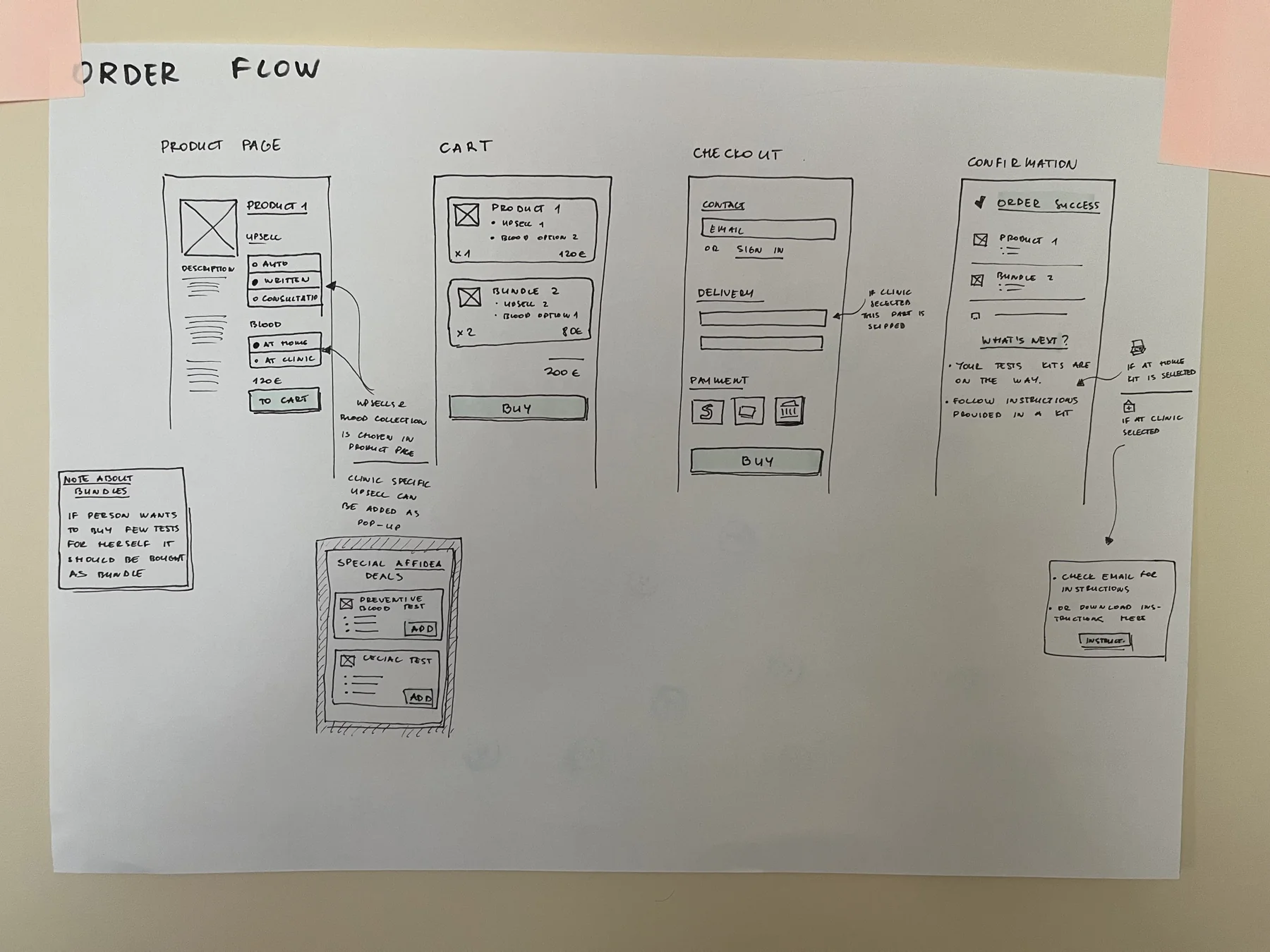
Together with allergists, we built the service in about two months and launched it in spring 2023: a landing page, symptom questionnaire, checkout, patient account and an admin tool for doctors. Patients gave a sample at a partner clinic. Their report showed which allergens were the likely cause of their symptoms, with a doctor's comments and recommendations.
THE JOURNEY
- spring 2023 launch
- late autumn 2023 new offer
- 14 months of 24% MoM growth
- mid-2025 €1.2M seed round
- late 2025 Self.co launch.
The problem
The first launch in Vilnius didn't take off: sales were slow and customer acquisition was costly. Customer interviews explained why. People who knew that private allergy tests cost around €200 saw our €60–90 price as a bargain. For everyone else, which was most of the market, it still felt expensive. We had built a consumer product but priced it for people who already knew the category.
Key decision: design the offer as a consumer product
In late autumn 2023, I reworked the offer. The same test now started at €29. The base report kept the part customers valued most, which allergens were likely behind their symptoms, and I simplified the standard interpretation to cut doctor time per order. In-depth interpretation and online consultations became paid upsells during onboarding.
The trade-off: lower revenue per base order and less doctor input by default. In return, a much lower barrier to the first purchase, and customers who wanted more could pay for it.
Deep dive: 14 months of 24% MoM growth
The new offer changed the dynamics of the business. Combined with new campaigns, it brought CAC down and order volume up. Upsells roughly doubled AOV from the €29 entry price to ~€58, keeping unit economics positive before fixed costs.
From there, revenue grew 24% MoM for 14 months, peaking at ~€70k/month at the end of 2024. Along the way we expanded to Poland and launched a second service, Food ID. I owned offer and package design, the upsell flow, pricing experiments and unit economics.
From traction to a €1.2M seed round and Self.co
That traction helped us close a €1.2M seed round in mid-2025. To pick markets, we mapped comparable at-home health-testing services and estimated their web traffic by country. The UK came out as the largest market in our sample, with Germany and the Netherlands ahead of most of the EU.
MARKET ANALYSIS
The UK stood apart.
1.57Mestimated visits / month
I brought both tests under one brand, Self.co, positioned around understanding allergy-like symptoms. A single brand let us sell the tests as a bundle and left room to add more services. We launched in late 2025, first in Germany, then the UK. After adjusting pricing and leading with the bundle, AOV reached ~€110, new markets grew to ~€25k/month within a few months, and the bundle made up more than half of Self.co revenue.
Results
- 24% MoM revenue growth for 14 months, from a few thousand euros to ~€70k/month
- Closed a €1.2M seed round (mid-2025)
- AOV €29 entry → ~€58 through onboarding upsells
- Expanded to Poland and launched a second service, Food ID
- Launched Self.co in Germany and the UK: ~€110 AOV, the bundle at >50% of revenue and ~€25k/month within a few months
What I'd do differently
Be more ambitious, sooner. We assumed a UK launch would be hard and expensive, so we started elsewhere. Later we found several simple ways in. Our biggest market was far more accessible than we thought, and I'd go for it earlier.
Add a subscription layer earlier. We stayed focused on one-off purchases for too long. A recurring element would have lifted LTV and made the business more resilient to rising CAC.
Treat platform policy as a core risk. We underestimated how much Meta's tightening rules on sensitive health categories would hurt us. They had a big impact on our later launches, and we weren't prepared.